Tel : (33) 770 38 84 34 Mail
Finding the Right Speed: What a French Farmhouse Teaches Us About Slow Tourism
Introduction: More Than Just a Destination
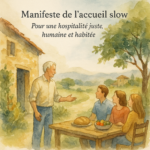
Visitors arrive at Les Meulières with a familiar mix of desire and fatigue. The old farmhouse doesn’t try to seduce; it is simply there, set in nature, offering a discreet comfort that never imposes itself. The silence isn’t empty; it’s welcoming. As one visitor deposits their bag, they remark, « I feel like we can finally put something down. » Another responds, « Yes… and not just our things. »
This brief exchange captures the essence of the journey ahead—a process of shedding more than just luggage. This document will explore the concept of ‘slow tourism,’ not through a formal definition, but through the tangible experiences of these visitors at Les Meulières, where a different way of traveling reveals itself one moment at a time.
——————————————————————————–
The experience of slowing down begins not with a grand excursion, but with a simple question posed on the very first evening.
1. The First Shift: The Shared Table
1.1. The Question That Changes Everything
As evening settles, an unexpected question circulates quietly through the house: « Do we all eat together? » After a moment’s hesitation, the host’s calm, self-evident smile provides the answer.
« Here, dishes love conversations. »
This simple invitation immediately shifts the focus from a collection of individual vacations to a single, communal experience. The large table becomes the center of this new dynamic, where guests find their voices and begin to truly connect.
1.2. Food as a Link, Not Just a Product
The dining experience at Les Meulières is governed by a different set of rules, where the meal becomes a medium for connection rather than a product to be consumed.
• Connection Over Credentials: Guests introduce themselves not by what they do for a living, but by what they love. This small change fosters a more genuine and immediate connection, bypassing the usual social formalities.
• The Pace of the Meal: Simple dishes, made from local ingredients, arrive slowly, as if respecting the natural rhythm of the conversation. The release from a hurried mindset is palpable, as one person admits, « It’s been a long time since I ate without looking at the clock. » Another host laughs and adds, « Here, it always ends up forgetting it exists. »
• The Beauty of Imperfection: One evening, the guests cook together. The resulting meal is not perfect—a little too salty, a little overcooked. But no one apologizes for it. This shared effort transforms a minor failure into a point of connection. As one guest notes:
Ultimately, the food ceases to be a product and becomes a « link »—a pretext for sharing stories, understanding where each person comes from, and discovering what still connects them to the world.
——————————————————————————–
This deliberate slowing of mealtimes is the first step toward a much larger realization: a fundamental change in the visitors’ relationship with time itself.
2. Redefining the Relationship with Time
2.1. An Economy Built on « Enough »
The next morning at the Sarlat market, another encounter deepens this understanding. A visitor, accustomed to the logic of maximization, asks a local producer about her day.
« Are you selling well today? »
The woman smiles, almost surprised by the question. « I sell just what’s needed, » she replies. « Then, I go home for lunch. »
On the drive back, the car is quiet for a long time before someone finally speaks. « Can you imagine, » they say, « an entire economy that rests on that sentence. » In that simple exchange, the group grasps a philosophy that values sufficiency over surplus, and life over labor. It’s a profound lesson not in commerce, but in contentment.
2.2. A Journey, Not a Checklist
As the stay draws to a close, the familiar anxiety of the modern traveler surfaces, a feeling of not having « done enough. » The response to this concern is both simple and profound.
Visitor: « We didn’t do everything… » Response: « Exactly. »
This brief dialogue illuminates a core tenet of slow tourism. The goal is not to accumulate a checklist of sights and activities, but to immerse oneself in an internal experience. The journey becomes a return to oneself, but never withdrawn. An opening, on the contrary. To nature, to others, to the world as it could be when we agree to slow down.
——————————————————————————–
As the pressure to do fades, it is replaced by the simple act of being, which is made possible by another often-overlooked element of the landscape: silence.
3. The Welcoming Sound of Silence
The silence found in the forests or overlooking the Dordogne valley is not empty or awkward. It is described by the visitors as « welcoming » and « comfortable. » It is a silence that doesn’t demand to be filled.
Its purpose becomes clear in another quiet exchange between visitors. The silence, one explains, creates « space… for oneself. And for others. » It is not an absence of noise but a presence of peace—a shared atmosphere that allows for deep reflection and connection without the need for constant words.
——————————————————————————–
These interwoven elements—the shared table that forges community, a new relationship with time, and the comfortable presence of silence—build upon one another. They culminate not in a collection of vacation photos, but in a subtle yet profound internal shift, the true takeaway of the trip.
4. The True Souvenir: A New Way of Being
At Les Meulières, slow tourism is not a « discourse » or a concept to be studied. It is a « lived culture »—a quiet, consistent attention paid to humanity, the land, and time. Because it is lived rather than explained, its effects are felt rather than learned.
The visitors realize they are leaving with something far more valuable than memories. As one puts it, they are leaving with « a way » of being. This way is composed of new, or rediscovered, habits of presence:
1. A way of talking to each other.
2. A way of eating.
3. A way of listening.
4. A way of being present.
This transformation is attributed to two key factors: the « quiet kindness of the inhabitants » and their profound « art of leaving space »—for silence, for slowness, and for others to simply be.
Conclusion: Finding the Right Speed
The experience at Les Meulières is ultimately about rediscovering a more human pace. It is a reminder that slowing down is not about losing time, but about gaining a richer, more connected experience of the world and of ourselves. The experience ultimately provides something rare and deeply soothing: the impression of having found, for the space of a stay, the right speed to be in the world.



 Se retrouver soi-même